
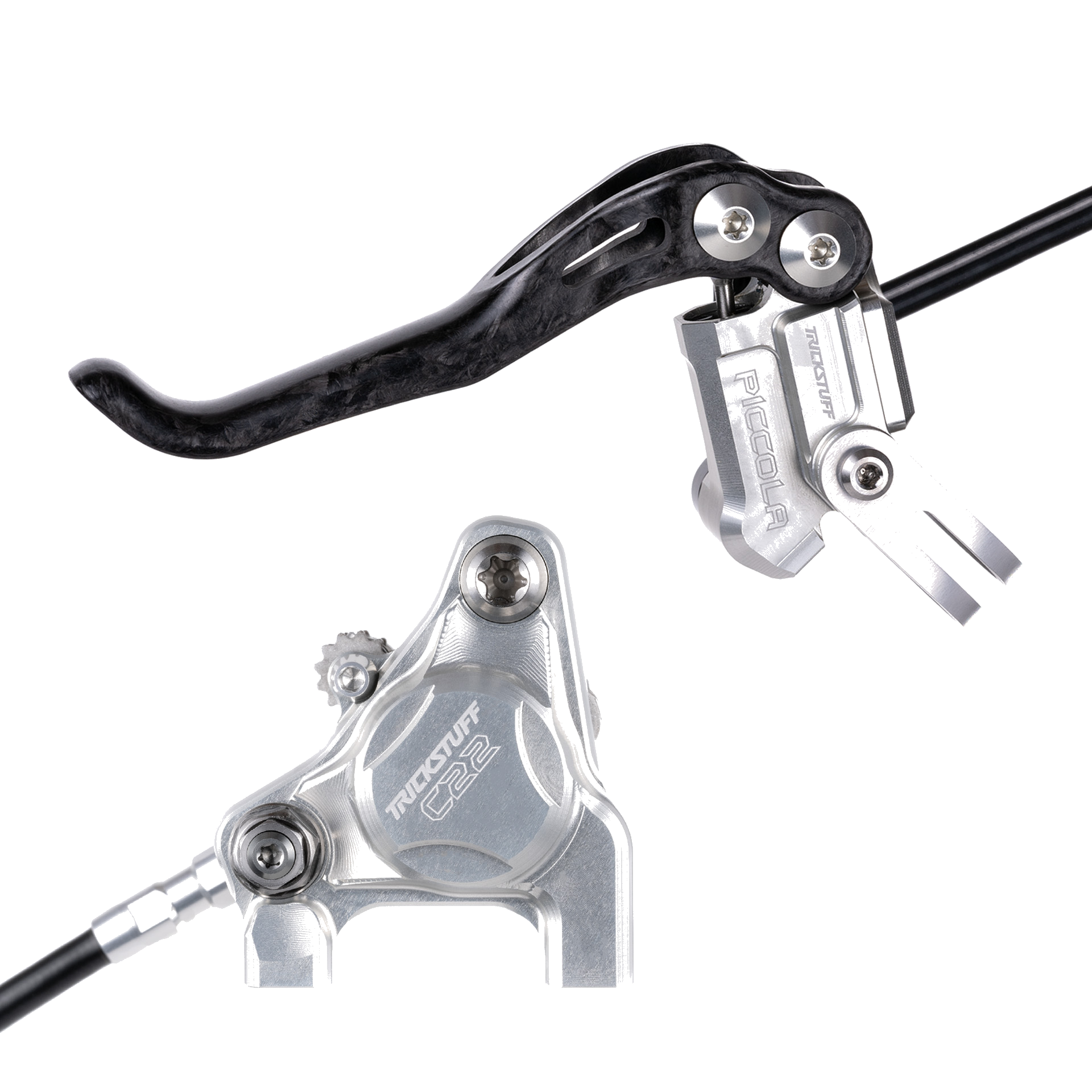
Trickstuff Piccola Carbon
The lightest brake with serious stopping power
Specifications
- Pistons
- 2-piston (22mm)
- Brake Type
- Hydraulic disc
- Hose Connection
- Angled fitting (internal routing)
- Brake Fluid
- Bionol (mineral)
- Reach Adjustment
- Yes
- Disk Size
- 140mm, 160mm, 180mm
- Disk Thickness
- 2.10mm
- Weight
- from 340g per set (160g per brake)
- Features
- Carbon lever, titanium yoke bolts, linear power transmission
- Blade Material
- Carbon
- Contact Point Adjustment
- No
- Lever Pivot
- Ball bearing
Overview
The Piccola Carbon strips every possible gram without compromising on feel or power. Carbon finger levers, titanium yoke bolts, and a weight-optimized caliper bring the system down to just 160g per brake — an almost cheeky combination of radically low weight and genuine stopping power. A 9mm pump piston transmits oil to two 22mm stainless steel pistons via linear power transmission, resulting in consistent, predictable braking force that remains faithful even at heart rates pushing 200. A benchmark choice for XC and marathon riders who refuse to give up control.
Features
Ultralight carbon finger levers
Two 22mm hollow stainless steel pistons
9mm pump piston with linear power transmission
Titanium yoke bolts on weight-optimized caliper
High-pressure Kevlar hose at 17g/m
Angled fittings for direct internal bar routing
Ball-bearing lever pivot
POWER ALU 830 pads compatible with SRAM 2-piston brakes
Class-leading weight at 160g per brake
Guides for setup
All guidesBrake Bed-in
The essential process for achieving maximum braking power.
Brake Bleeding
System-specific bleed procedures for Shimano, SRAM, and Magura — eliminate lever sponginess and restore full power.
Weather & Conditions Adaptation
Setup adjustments for wet, muddy, dry, and cold conditions — tires, suspension, drivetrain, and brakes.
How we evaluate this component
Product cards, analysis notes, and setup guidance are grounded in public specifications, market positioning, compatibility, and the most likely real-world use cases on trail.
Read the full methodology